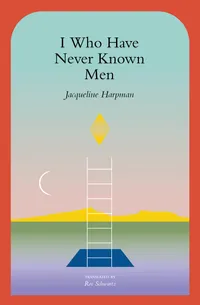
I Who Have Never Known Men
This summer I found this book featured in a sci-fi list and as MANY times before, I liked the cover art. I did also read what it was about 😅.
Anyway, I was under the impression that this was a more recent book. I didn’t realize it’s currently living a second life, because this book was released in 1995. While it didn’t get a ton of traction back then, it found a new audience now, including myself.
And rightfully so, it’s an amazing book!
I forgot it was listed as both Science Fiction and Dystopia when I was reading it. It touched on so many philosophical points that you stopped questioning the surroundings and the absurdity of the place where the action takes place.
The premise of the book, as described in every synopsis, is this:
Deep underground, forty women live imprisoned in a cage. Watched over by guards, the women have no memory of how they got there, no notion of time, and only a vague recollection of their lives before.
The whole book is from the perspective of “the Child.” One of the women in the cage is an actual child who was probably 1–2 years old when she was added to the cage with the 39 other women.
This child grew up knowing nothing except life in the cage. She has no recollection of things outside the cage. While the other women had lived in the outside world, they can’t remember much about how they ended up in the cage.
This whole setup made me think about “The Allegory of the Cave,” explained by Plato in The Republic.
When the book starts, the child is around 12–13 years old and has lived her past 10 years in the cage.
She’s a child who didn’t receive any physical attention or love (as one of the rules was no touching in the cage). She’s frustrated by the adults, thinking they are stupid and uninteresting. She feels neglected and not part of the women’s group. There is no one her age; the youngest woman is in her late 30s. The Child feels that, not having experienced life outside the cage, she is the only one who can’t understand love, men, and all the things the other women had in common.
She feels left out, alienated even inside the cage in this small group that should be her peers.
Much later, she is able to realize that, in the end, she was human and able to have all these feelings that make you human.
The first pages of the book made an impact on me.
Talking about the preface of books where authors thank those that helped them along the way, she says:
[…] I usually read these words with a degree of indifference. But suddently, yesterday, my eyes filled with tears; I thought of Anthea, and was overcome by a tremendous wave of grief. I could picture her, sitting on the edge of a mattress, her knees to one side, sewing patiently with her makeshift thread of plaited hairs which kept snapping, stopping to look at me, astonished, quick to recognise my ignorance and teach me what she knew, apologising that it was so little, and I felt a huge wrench, and began to sob. I had never cried before. There was a pain in my heart as powerful as the pain of the cancer in my belly, and I who no longer speak because there is no one to hear me, began to call her. Anthea! Anthea! I shouted. I couldn’t forgive her for not being there, for having allowed death to snatch her, to tear her from my clumsy arms.
Following with:
I was forced to acknowledge too late, much too late, that I too had loved, that I was capable of suffering and that I was human after all.
This is a recurring theme in the book: What makes you human? Are you human even if you didn’t grow up with the same values, didn’t share the same experiences, don’t understand what beauty and art are, didn’t know your parents’ love, didn’t love and grieve after someone?
Back to the the Child inside the cage, as she started to become aware:
For a very long time, the days went by, each one just like the day before, then I began to think, and everything changed.
While she can’t have the same experiences the other women had, she is able to fantasize about them and create her own little world inside her head. She has a place of her own, and this drives the women mad that she has a secret and doesn’t want to share it.
There was a time, before I’d found the inner world where I enterained myself, when I was still inquisitive and docile, when I’d have been intimidated. I’d have wonder what I’d done wrong to deserve this scrutiny, and I’d have feared the punishment. But now I knew I was beyond their reach: punishments were never more than being left out, excluded from futile, flighty conversations about nothing in particular, and that was all I wanted so that I could continue my secret pursuit in peace.
The other women demand that she share the secret with them.
“I said I wouldn’t tell you my secrets. You told me you wanted them. That’s not telling me anything new, I was already aware of that. You think you ony have to tell me you want to know for me to tel you.”
That was indeed what she thought.
“That is how things should be”, she insisted.
“Why?”
She was disconcerted. […] she was shocked that I could have asked it. […] She’d never questioned that, but, I who had grown up in the bunker, had no reason to comply.
With this newfound power, she confronts the other women.
“You’re a fool”, I retored, intoxicated by my new-found certainties. “And this conversation is absurd. You think you have power but you’re like the rest of us, reduced to receiving your share of food from enemy hands and with no means of punishing me if I rebel against you. Seeing as they forbid any authority other than theirs, you can neither beat me nor make me go without. Why should I obey you?”
While she starts developing an interest in the guards, she decides to count the guard shifts with her own heartbeat. There were no clocks; there was no notion of time. Night and day were dictated by the bunker where the cage was.
She notices a difference in the intervals between guard changes and decides to share that with the women. From this moment, a connection is made. They are able to figure out that it’s an artificial day/night system. She becomes their clock; she is the one who counts everything now.
One day, when the guards open the gate to bring in the food, a siren goes off blaring. All the guards leave in a hurry, and the women are left there with the gate open, not knowing what to do.
Here they are with this new freedom. They manage to go out and reach the surface to find nothing but a plain that goes on and on with little change in elevation.
This freedom brings hope, joy, a desire to explore, and a need to find out what was happening, to go and find others, reach a city, and get back to the world they knew.
Exploring, they find more and more bunkers, but still no survivors.
Here, the siren had gone off in the middle of the artificial night, the door was locked and the guards - of course! - hadn’t bother to open it. The women had tried. They’d died of grief, long before hunger had killed them.
It’s a fragile hope. Once you realize you might actually be all alone, just the 40 of you left on this world with a Dali-esque landscape that you know nothing about, all hopes and purpose go away. The lack of purpose can break the human spirit, make you idle around, waiting for it all to end, just give in and drift away.
After years of roaming the land, from bunker to bunker, they never find another survivor, another sign of life, no city, no man-made structure apart from the cabins that served as the entrance to the bunkers that hosted the same cage with 40 people (sometimes women, sometimes men), an absurd amount of food in cold storage rooms, no explanation of what is happening, why there is electricity, no clue what this planet they’re on is, no one to remember them.
No other cage ever had an open door.
We were going to die one by one without having understood anything of what had happened to us and, as the years went by, our questions petered out.
Old age and illness slow them down, and they settle. They build a few houses, live, and try to find some purpose in this new scenario where they have to accept no one else exists.
Not dealing with emotions in the same way as the rest helps her become the one who carries out the task of ending a life of suffering for women in the group. As a last resort, they ask her to do it, and she gives them this final gift.
None wanted to endure pain and I think they were in a hurry to die. I don’t know how many I killed - I who count everything, that was one thing I didn’t count.
As the last woman dies, the Child is set free and starts to go again, exploring the world. She wants to believe there is so much more and maybe they settled too soon.
In one of the cages, she discovers a man who died without begging. He accepted his fate; more than that, he welcomed it, dying of his own accord. This final gesture that no one could take away, not even decades lived in a cage or years passing by until being discovered, marks her.
His torso was half clothed in a torn tunic. I could see the powerful bones of a shoulder that must have been strong. I felt a surge of grief, I, who had never known men, as I stood in front of this man who had wanted to overcom fear and despair to enter eternity upright and furious. I sighed and left.
This image will stay with her up until her final moments, years later, when she’s going to use the knife to put an end to her adventure after traveling for thousands of hours, reaching over 60 years and beginning to fall sick, knowing as much and as little about why she’s here as she did the moment she started to think inside the cage.
She finds a different bunker, one that has all the amenities the women talked about. It’s more like a house that’s going to be home for the last part of her life. And it even has books, which she reads and rereads for years.
But most importantly, it has paper, to write this story and leave it for:
[…] an astounded human being, arriving at the foot of the stairs as I did so long ago, will see the dark wood-panelled room, the neatly arranged bet, and an old woman sitting upright, a knife in her heart, looking peaceful.
Even after rambling this much, there still is a lot in the book to discover, and I feel I’m not able to do it justice in describing how good it is.
There is such a calm tone throughout the book and a feeling of making peace with everything, no matter how absurd this adventure is for the narrator. She spends her final month recalling and writing this down for a potential human who will learn about her story. It’s not the happiest, as she says, but it’s hers. Each story counts.